Expertises/Cultural buildings/Museum facade

Museum facadeengineering forsignature cultural projects.

Museum facade engineering sits at the intersection of architectural signature, collection preservation and institutional durability. The envelope of a signature cultural building must simultaneously deliver UV control for artwork preservation, fine daylight management for exhibition spaces, thermal regulation stable enough to hold the narrow hygrothermal envelopes required by conservation protocols, structural glass performance for iconic transparency, and a service life compatible with the patrimonial horizon of the institution. Our atelier engages on these projects as specialist facade engineering firm, in direct contract with the owner or in subcontract to the signature architect.

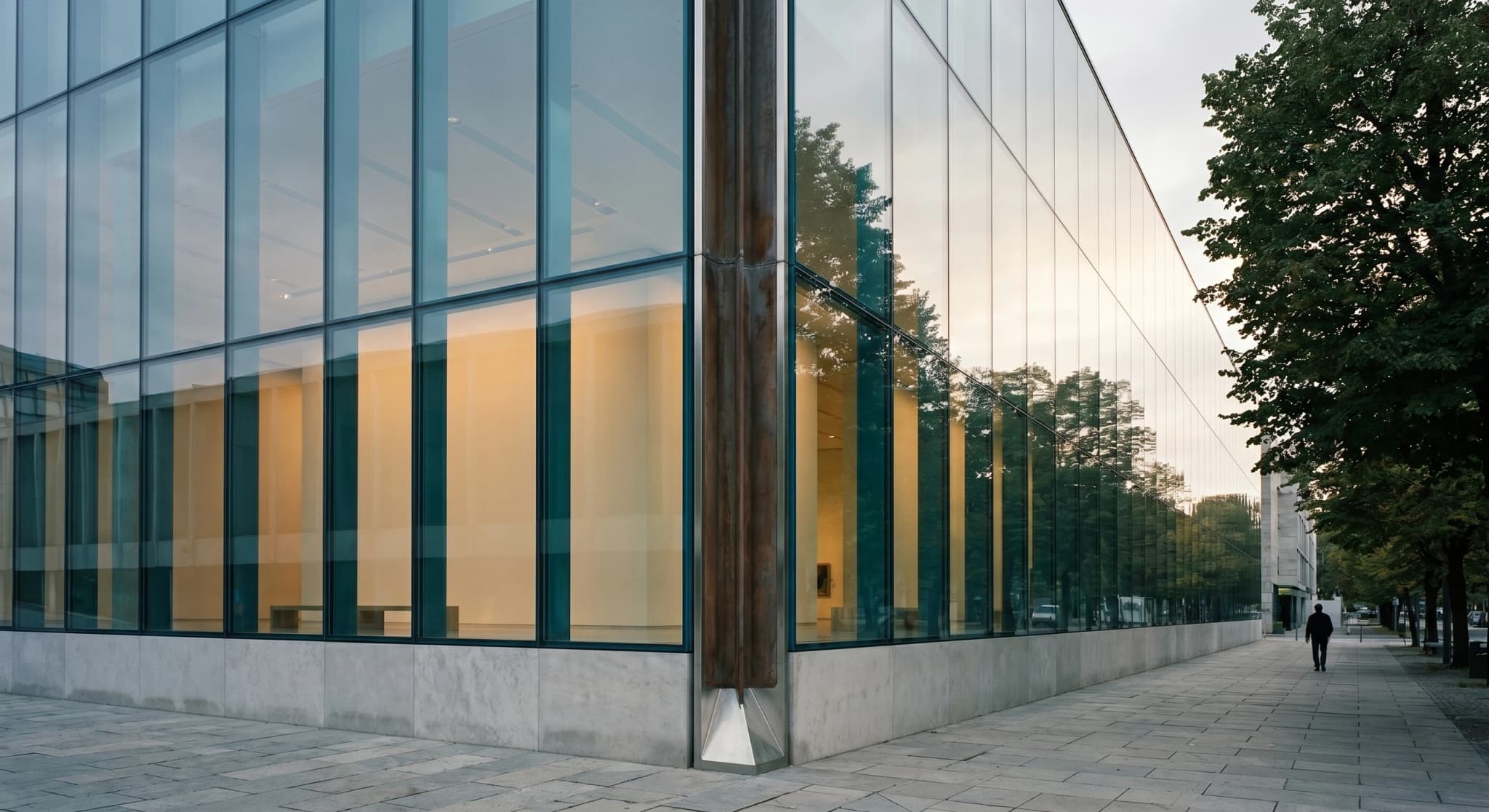
Museum facade engineering, contemporary institutional envelope with jumbo glazingPL.127 · Museum
01 / 01Contemporary institutional envelope, jumbo glazing.
© S&P · Sprint 3
01Plate 01 / 06, Challenges

Specific challenges : UV, thermal, preservation.

Four technical challenges structure museum facade missions, distinct from standard tertiary or residential projects. Each carries its own quantitative envelope and its own conservation rationale.

01 / 01Constraint 1, conservation

UV control.

Below 75 μW/lumen on sensitive works ; below 10 μW/lumen on paper.

UV accelerates pigment degradation, paper yellowing, textile fibre breakdown. Museum conservation protocols typically limit incident UV to below 75 μW/lumen on sensitive works, below 10 μW/lumen on paper. Envelope specification delivers this through spectrally selective coatings, laminated interlayers with UV-blocking PVB/SGP additives, and electrochromic or variable-tint glazing where natural-light fluctuation requires it.

Threshold sensitive
75 μW/lumen
Threshold paper
10 μW/lumen
75 μW/lm10 μW/lm paperUV-PVB
02 / 02Constraint 2, hygrothermics

Thermal & hygrothermal regulation.

19-21 °C, 45-55 % RH, narrow variation rates per hour.

Conservation protocols require stable conditions in narrow ranges : 19-21 °C, 45-55 % RH, under 2 °C per hour, under 5 % RH per hour. Envelope design limits thermal bridges, minimises radiation gain/loss, contributes to HVAC stability without mechanical overload. Multi-layer IGU, vacuum-insulated glazing, active thermal-management facades per project register.

Variation rate T
under 2 °C/h
Variation rate RH
under 5 % RH/h
19-21 °C45-55 % RHNarrow
03 / 03Constraint 3, durability

Preservation-grade durability.

50 years or more without major renovation.

Museum envelopes operate on 50+ years without major renovation. Material choices, detail design and maintenance protocols anticipate this horizon : corrosion-resistant fasteners, accessible maintenance zones, component replaceability documented from design phase, interior protection during any facade intervention. Replacing a single element 10 years post-handover cannot expose the collection to ambient conditions for hours.

Horizon
50+ years
Constraint
Interior protection during intervention
50+ yr horizonCorrosion-resistantReplaceability
04 / 04Constraint 4, light

Daylight & glare control.

Daylight required, glare on artwork rejected.

Museum spaces require daylight but reject glare on artwork and circulation. Indirect daylighting through clerestories, light shelves, diffusing glazing or controlled skylights is standard practice. The facade contributes to the light strategy, it does not just contain it. Envelope + daylighting are co-designed from sketch phase ; sequential decisions produce signature projects that fail conservation at commissioning.

Phase
Co-designed from sketch
Test
Glare-free at commissioning
IndirectClerestorySkylight
02Plate 02 / 06, Structural glass

Structural glass and jumbo glazing.

Signature museum architecture frequently mobilises structural glass and jumbo glazing for transparent facades, skylights and connecting volumes. Two readings co-exist : the technical scope and the conservation-aware calibration.

01 / 01Reading 1, scope

Technical scope.

Glass beams + columns, point-fixed, multi-layer laminated, cold/hot-bent.

Our structural glass and jumbo glazing expertise applies directly : glass beams and columns, point-fixed connections, multi-layer laminated SGP/ionoplast, cold/hot-bent formats. Reference furnaces IT/DE/BE for jumbo up to 3.2 × 18 m.

Reference furnaces
IT · DE · BE
Connection types
Point-fixed · spider · SSG
SGPIonoplastCold/hot-bent3.2 × 18 m
02 / 02Reading 2, calibration

Conservation-aware calibration.

UV-filtering, IGU thermal target, post-rupture redundancy occupants + collections.

The structural glass engineering integrates conservation constraints. UV-filtering interlayers and spectrally selective coatings specified from design stage. IGU thermal performance calibrated to the conservation target, not generic tertiary. Post-rupture redundancy dimensioned to protect both occupants and collections.

Specification
From design stage
Redundancy
Occupants + collections
UV interlayerConservation IGUDual redundancy
03Plate 03 / 06, Daylighting

Indirect daylighting and glare control.

Museum envelope engineering typically articulates with the daylighting strategy of the exhibition spaces. Five canonical devices structure the indirect-daylighting approach. Each is a facade engineering decision, not a separate consultant scope.

01 / 05Clerestory

Clerestory glazing

High windows that diffuse light into the volume from above.

Reduces direct sunlight on artwork by elevating the daylight source above the gallery walls. Combined with internal light-coloured ceilings to spread the light evenly across the exhibition volume.

High windowIndirect
02 / 05Light shelf

Light shelves

Horizontal reflective elements bouncing daylight onto the ceiling.

Distributes daylight evenly toward the back of deep galleries by reflecting it on the ceiling. Critical for tall exhibition rooms where direct windows would create unacceptable contrast at floor level.

ReflectiveDeep galleries
03 / 05Diffusing

Diffusing glazing

Etched, sandblasted, or fritted glass.

Softens direct solar gain while maintaining luminous efficacy. Spec choice between acid-etched, sandblasted and ceramic fritted depends on the spectral response and the conservation target. Frit pattern density tunes the diffusion-vs-clarity balance.

Acid-etchedSandblastedFrit
04 / 05Electrochromic

Electrochromic glazing

Dynamic tint modulation, BMS-integrated.

Variable tint for zones exposed to direct sun, with BMS integration to the museum's environment-monitoring system. The glazing tint adapts to the conservation set-point in real time, reducing the HVAC load on shoulder seasons.

BMSBACnet/KNX
En savoir plus
05 / 05Skylight

Skylights with shading

Integrated solar-control shading and UV filtering.

Vertical or roof skylights with integrated shading systems and UV-filtering interlayers. Most demanding configuration for thermal performance ; multi-layer IGU and dynamic shading typically required.

Integrated shadingUV interlayer
04Plate 04 / 06, Technology

Technology integration.

Museum facades increasingly integrate technology. Components must respect preservation and durability constraints : documented service life, redundancy on critical functions, cybersecurity of the integrated IoT, maintenance accessibility.

Four integrated systems

Electrochromic glazing for dynamic daylight and solar control. Integrated sensors for monitoring exterior conditions (solar, wind, temperature, humidity) that feed the HVAC and conservation monitoring systems. LED-integrated glazing for scenography or façade animation on signature landmarks. Security integration : anti-intrusion RC4-RC6 per EN 1627 on entrance zones, blast-resilient glazing on high-profile institutions. See Smart skin & electrochromic and Anti-intrusion RC4-RC6 for the broader scope. Technology integration on museum envelopes must respect the preservation and durability constraints : components with documented service life, redundancy on critical functions, cybersecurity of the integrated IoT, maintenance accessibility.

05Plate 05 / 06, References

Reference projects.

Signature museum projects mobilise our atelier as specialist facade engineering firm, in direct contract with the owner (ministère de la culture, fondation privée, trust institutionnel) or in subcontract to the mandating architect. References are presented in meetings under NDA, not publicly.

Industrial grounding, founder formula

Seventeen years in the envelope industry, including several years in pre-construction with a Tier-1 international contractor in glass envelope works.

Direct industrial-grounding knowledge of the European and international glass processors capable of delivering signature museum envelopes at the required scale and quality, with the conservation-aware interlayer supply chains and the preservation-grade durability protocols that distinguish a signature museum mission from a high-end tertiary one.

Confidentiality

Reference projects span Europe, the Middle East, Asia and North America, in segments including signature museums, foundation buildings, cultural institutions and heritage renovations. Our references do not figure publicly, out of respect for the confidentiality owed to architects and to institutional owners. They verify through the right channels : direct discussion with the architect's office, with the institution's project manager, or with our atelier's senior associate under NDA.

06Plate 06 / 06, Articulation

Continue reading.

Six canonical entries to articulate museum facade engineering with adjacent practices.

01 / 06Glass

Structural glass & Jumbo

DIN 18008, EN 16612, up to 3.2 × 18 m.

DIN 18008
En savoir plus
02 / 06Smart skin

Smart Skin & electrochromic

Dynamic glass, BMS, BACnet/KNX integration.

BMS
En savoir plus
03 / 06RC4-RC6

Anti-intrusion RC4-RC6

EN 1627, classes RC4 to RC6.

EN 1627
En savoir plus
04 / 06EE

Envelope Engineering

Concept to punch list.

BET
En savoir plus
05 / 06Design

Design Integrity

Protection of architectural intent.

Intent
En savoir plus
06 / 06LEC

Lead Envelope Consultant

Pillar engineering and design-chain leadership.

LEC
En savoir plus

A museum facade to engineer?

A signature museum in early design, a cultural project with collection-preservation constraints, or a museum renovation where the envelope engineering conditions the exhibition programme. Describe the project, the institutional context and the architect. Confidential exchange, NDA on request.

Confidential brief
Shili & PartnersA Shili Build Ventures company