01 / 08UHNWI
UHNWI residences
Elevated risk profile: celebrities, exposed executives, families with specific threats.
DiscretionTargeted risk
Designing an envelope rated RC4, RC5 or RC6 per EN 1627 to withstand determined forced-entry attempts, while preserving the architectural appearance of a standard facade, occupant comfort and design integration. Our missions cover risk analysis, integrated system design (glazing + framing + hardware + anchorages), qualification tests EN 1628-1629-1630 and certification by independent laboratories. UHNWI clients, signature jewellery stores, banks and museums value invisible protection: they do not want to live or work in a bunker.
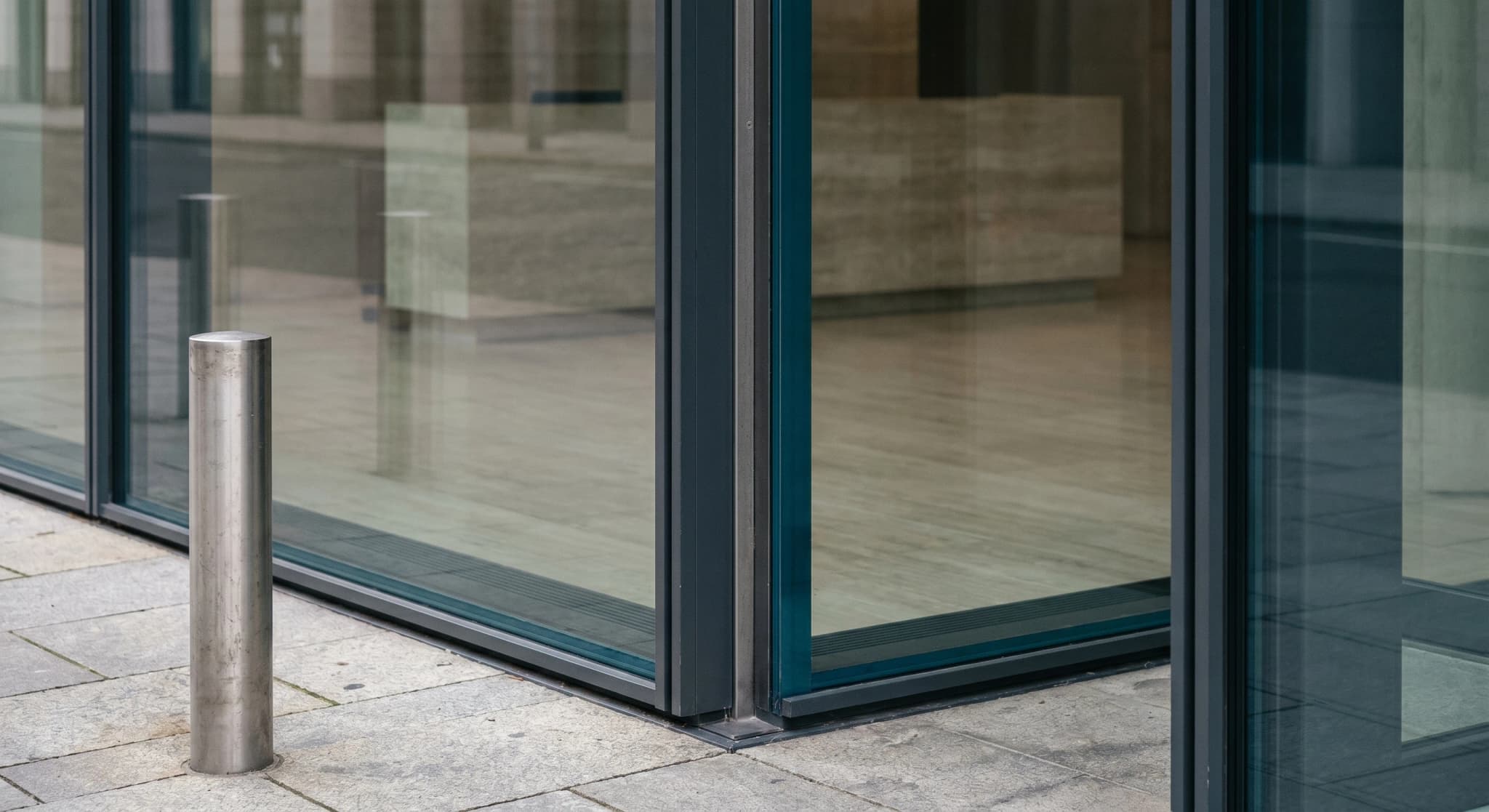 PL.022 · RC4-RC6
Eight project configurations regularly mobilise an RC4 to RC6 rating. They share a common feature: a tangible, planned or organised threat that justifies passive investment where alarms and guards no longer suffice.
Elevated risk profile: celebrities, exposed executives, families with specific threats.
Signature art galleries: Place Vendôme, Bond Street, via Montenapoleone. Architectural quality and prolonged resistance.
Signature branches, back-offices, vault rooms. Asset protection and insurance compliance.
Proprietary R&D, industrial secrets, confidential prototypes. Physical protection of the intellectual perimeter.
High-value collections. Protection conditions the insurance policy and international loan agreements.
Fine wines, classic cars, art, patrimonial vaults. Building safekeeping in addition to vault safekeeping.
Classified data centres, trading floors. Operational continuity and flow confidentiality.
Diplomatic, often combined with blast requirements.
EN 1627 defines six classes of resistance to forced entry, calibrated by resistance time against a defined threat profile. This referential structures everything that follows: classes RC4 to RC6 mark the threshold above which envelope security engineering adds value.
| Attribut | ClassRC | TimeMin. | Threat profileTools |
|---|---|---|---|
| RC1 | 3 min | Opportunistic, poorly equipped attempt (shoulder, kick) | |
| RC2 | 3 min | Simple tools (screwdriver, pliers, wedges) | |
| RC3 | 5 min | Extended tools (crowbar, reinforced screwdriver) | |
| RC4 | 10 min | Experienced burglar (saw, hammer, axe, hand drill) | |
| RC5 | 15 min | Qualified threat (power tools, angle grinder) | |
| RC6 | 20 min | Equipped threat (heavy equipment, high-power angle grinder) |
Classes RC1 to RC3 are covered by standard secured joinery on the market, often without specialist engineering. Classes RC4 to RC6 concern high-risk projects. This is where envelope security engineering adds value: calibrating the protection level to the real risk, designing the complete system in an integrated manner, and obtaining EN 1627 certification without architectural compromise.
Four phases structure the method, from risk analysis to certification. Each phase produces a contractual, signed deliverable that becomes the reference for the next phase.
Identification of assets to protect: people, goods, data, collections. Retained threat profile: opportunistic, planned, organised. Response time of intervention services: police, private security, integrated guard teams. Determination of the target RC class, calibrated to real risk without over-investment. The analysis is documented as a note that justifies every class choice and becomes the contractual reference for the rest of the mission.
Anti-intrusion does not apply to the glass pane alone: it is a complete system, where the weakest link determines global performance. Multi-layer laminated glazing, reinforced framing, certified hardware, anchorages, fixed glazing: five sub-systems calibrated together (detailed below).
Dynamic tests EN 1629: hard- and soft-body impacts simulating early attack phases. Static tests EN 1628: loads applied to identified weak points. Manual tests EN 1630: simulated attack by experienced burglar with a toolkit calibrated to the target class, performed by certified operators at an accredited laboratory.
Anti-intrusion must be invisible. Standard-appearance glazing (no fortified look). Architectural profiles identical to non-secured joinery on the rest of the building: same reveals, same finishes, same proportions. Hidden or design-integrated hardware. Absence of visual signals that would reveal the presence of reinforced protection, a particularly structural point for UHNWI residences whose owners reject a security appearance.
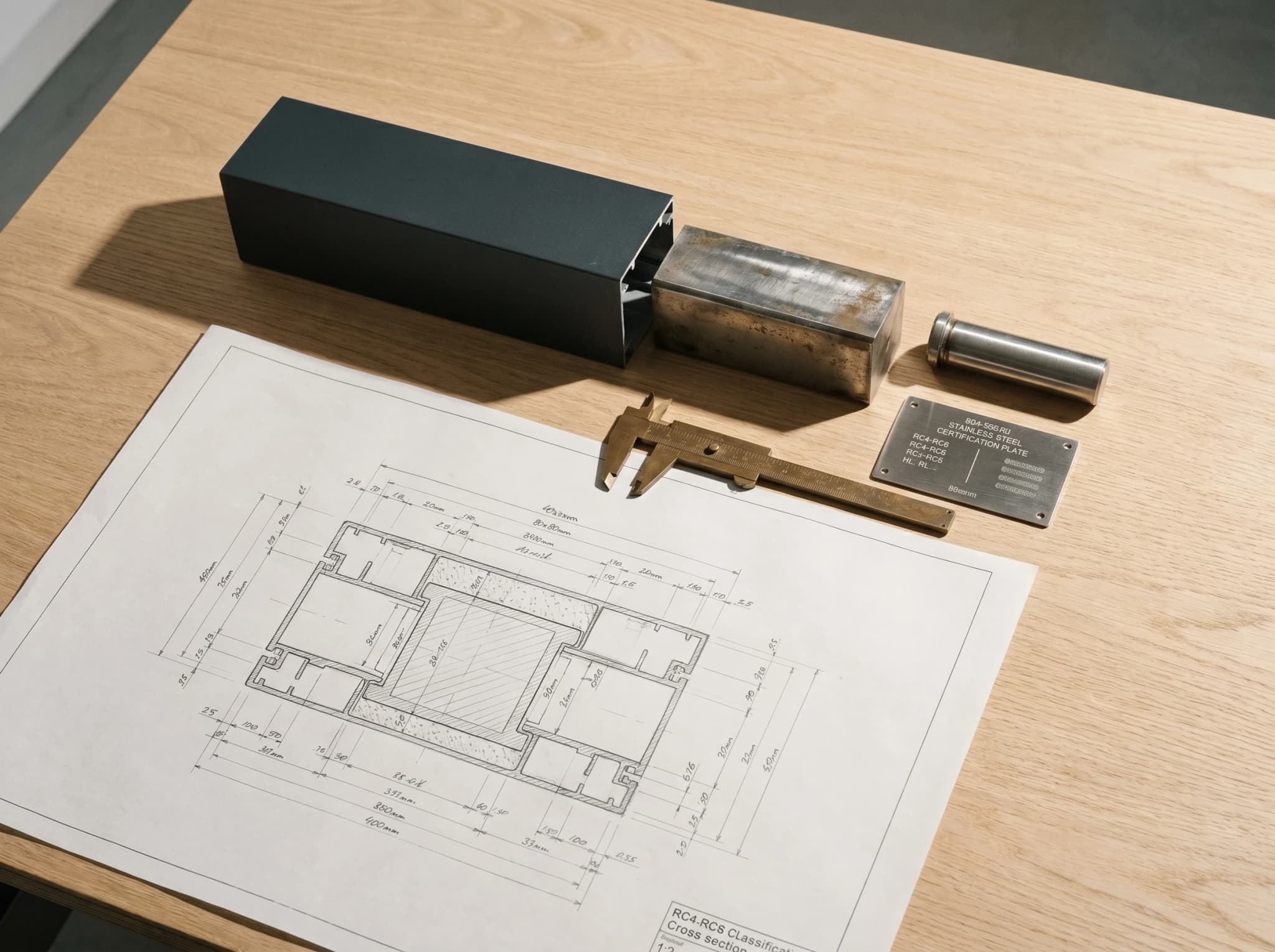 FIG. 03 · Mullion
Laminated glass P6B, P7B or P8B per EN 356 (manual-attack resistance). Integrated security films between glass layers. Thicknesses and compositions calibrated to the target RC level.
Specific aluminium or steel. Invisible metal reinforcements integrated into profile chambers. Triple barrier: opening sash, fixed frame, anchor link, dimensioned to absorb successive attack phases.
Multi-point locks SKG, A2P or VdS per RC class. Anti-lift and anti-extraction hinges. Reinforced espagnolette rods. Hardware independently qualified.
Fastenings to the primary structure. Number and spacing per EN 1628 to 1630, accounting for dynamic and static loads during the test duration.
Anti-extraction glazing beads, certified structural bonding for fixed panels, joint protection against mechanical extraction.
Four requirement combinations coexist regularly on high-risk-profile projects. Anti-intrusion rarely lives alone: it is calculated with the neighbouring registers, sometimes complementary, sometimes antagonistic.
For embassies, sensitive headquarters, very-high-risk UHNWI residences.
Design reconciles the two requirements, often complementary (thick multi-layer glazing satisfying both registers), sometimes antagonistic: a dissipative blast anchor can weaken static intrusion resistance, requiring combined calculation. See Blast resilience.
For buildings open to the public (ERP) or high-rise buildings (IGH).
Protection against intrusion combined with fire resistance EI30, EI60 or EI90 per typology. Anti-intrusion and fire certifications are tested separately, but products must satisfy both specifications on the same component.
For very-high-risk UHNWI profiles.
Combination of P7B or P8B anti-intrusion glazing with FB-class ballistic glazing per EN 1522-1523, applied to exposed building zones.
Vibration, opening, glass-break sensors. Detection enriches, does not replace.
Integration of electronic sensors complementing the system's passive resistance. Active detection does not replace passive resistance; it enriches it. See Smart skin & electrochromic for active facade-integrated technologies.
The anti-intrusion normative corpus is European and multi-jurisdictional on components. Our practice mobilises the following nine references daily.
Classification RC1 to RC6 of forced-entry resistance of doors, windows, shutters and closures.
Test method for the determination of resistance to static loads.
Test method for the determination of resistance to dynamic loads.
Test method for the determination of resistance to manual forced-entry attempts.
Classification of glazing resistant to manual attack, classes P1A to P8B. P6B, P7B and P8B classes are particularly relevant for RC4, RC5 and RC6 glazing.
Heat-soaked thermally toughened safety glass, applicable to RC5-RC6 glazed components.
German security standards, applicable in DACH jurisdictions.
Loss Prevention Standards (UK), applicable in UK jurisdiction and on international projects that activate them.
Dutch certification for hardware and secured joinery.
Three elements structure our anti-intrusion practice. They converge toward the same promise: right-sized protection, design preserved, neutral coordination.
Over-investing costs and harms daily building use.
Our documented risk analysis allows right-sizing: no more, no less. Method discipline protects both budget and use value.
Field knowledge of European secured-joinery supply chains.
We know how to design RC4-RC6 rated facades that look exactly like a standard facade, because seventeen years in pre-construction taught us what industrial supply chains actually produce, and where their aesthetic margin lies.
No exclusive partnership with a manufacturer or glass processor.
On projects combining anti-intrusion, blast, fire and smart detection, technical and budgetary coherence across these registers is what makes the project tenable. We recommend the combination adapted to the project, from documented competitive benchmarking. See Technological neutrality.
Anti-intrusion missions on UHNWI residences, signature jewellery stores and banks are conducted under strict rules. Discretion is a condition of practice, not a commercial constraint.
Systematic NDA before the first technical conversation. Dossier isolation within the atelier: only direct participants access deliverables. No public reference without explicit written consent of the owner.
This specialty connects with our other expertises and engineering methods. Three canonical entries to calibrate a combined mission.
Blast and ballistic design: ISO 16933/16934, UFC 4-010-01, GSA.
Dynamic facade: dynamic glass, BMS control, BACnet/KNX integration.
Structural, thermal, computational, interface design: envelope engineering core.
No hidden commissions, no captive system: documented open arbitration.
Owner profile: value protection, asset engineering, independent audits.
Our eight state-of-the-art specialties on risk- or signature-grade typologies.