§ 03Architecture
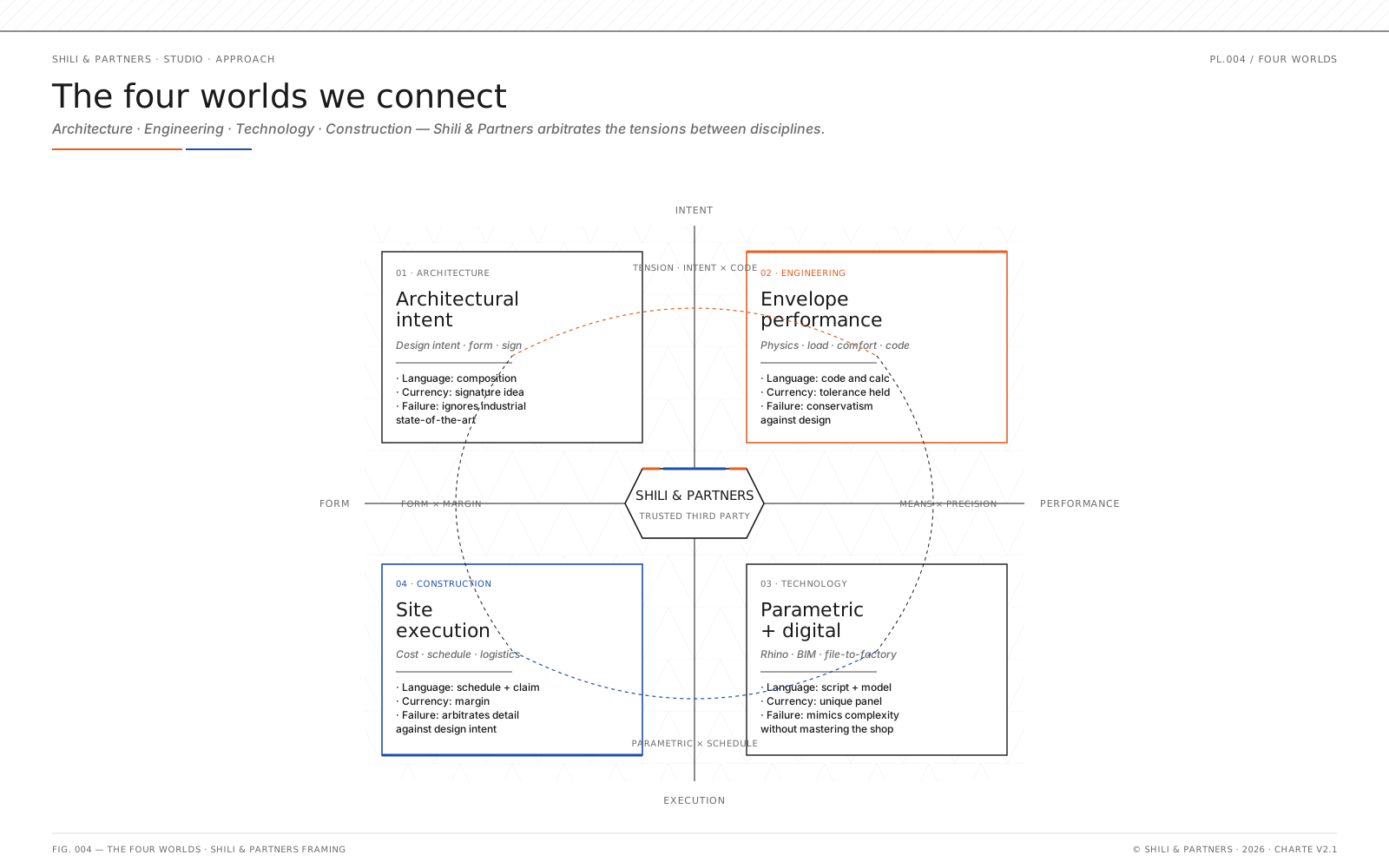
Architecture defines the intent : form, material, light, the interior-exterior relationship, the urban presence. What makes a building that particular building and not another. On the projects where we engage, architectural intent is an invariant to respect, not a constraint to negotiate downward. Our role in dialogue with the architect is twofold : sufficiently fluent in their language to understand their real invariants (what cannot be touched without betraying the project) and their margins of manoeuvre (what can evolve without loss of identity). This discernment, which is not taught in engineering schools, is what makes the dialogue productive.
§ 04Engineering
Engineering imposes the laws of physics, climate, mechanics and carbon. Structure, thermal performance, acoustics, building physics, wind resistance, seismic behaviour, fire behaviour, each dimension has its own requirements and reference standards. SIA, Eurocodes, DTU, FIDIC contractually : engineering is the world of non-negotiable constraints. Our specificity within engineering is the dual competence : rigorous structural and thermal calculation on one side, computational design on the other. Most engineering consultancies can calculate. Few can also model parametrically and optimise geometrically within the calculation process.
§ 05Technology
Technology, simulation, parametric modelling and digital fabrication tools, offers spatial computing and file-to-factory capabilities still under-exploited in the envelope industry. Digital twins applied to fabrication, tolerance simulation, geometric rationalisation through algorithms, direct extraction of manufacturing data from the 3D model, these are optimisation levers that reduce costs, accelerate cycles and reduce claims risk.
§ 06Construction
Construction, general contractors, total contractors, specialist facade companies, system suppliers, manufacturers, bears the tolerance, budget and supply-chain risks generated by the three other worlds. It is in construction that the errors of upstream phases cost the most. Our studio was founded from the construction world. We know what a tolerance imprecision costs on a 20,000 m² curtain wall project. We know what an insufficiently coordinated shop drawing package generates in claims. That knowledge informs our upstream work, from concept phase.
The four worlds do not reconcile through good will ; they connect through method. The method begins at concept phase, when choices are still reversible at marginal cost, and continues through to defects liability period. When only one of the four worlds is missing in the design room, it returns on site as variations, claims or sacrifice of intent. That is the gap our approach is built to close.
§ 06·BThe integrator's posture
Connecting the four worlds is not a matter of weight at the table ; it is a posture. The studio sits at the centre of the quadrant not as a referee but as an integrator, translating each world's constraints into the others' vocabulary. Architects hear performance, structural and cost reasoning ; engineers hear intent and aesthetic invariants ; technologists hear constructive logic and tolerance ; contractors hear design rationale and lifecycle. That translation work is what allows the four registers to converge on a coherent solution rather than diverge into late compromises.