Studio/Our approach/Trusted third party

Our approach,trusted third party.

The structural problem of the building envelope industry is not technical. It is one of alignment. The architect defends design intent. The engineer defends code compliance. The contractor defends margin. The owner defends budget. Each has legitimate reasons. But four partially divergent interests do not spontaneously produce a building that respects all four. They produce compromises that nobody actually wanted. Our position is that of the trusted third party facade advisor, the counterpart whose sole mission is to defend the project's interest.

Shili Partners approach, the equation design intent × budget × SOTA resolved as three objects in balanceEN.004
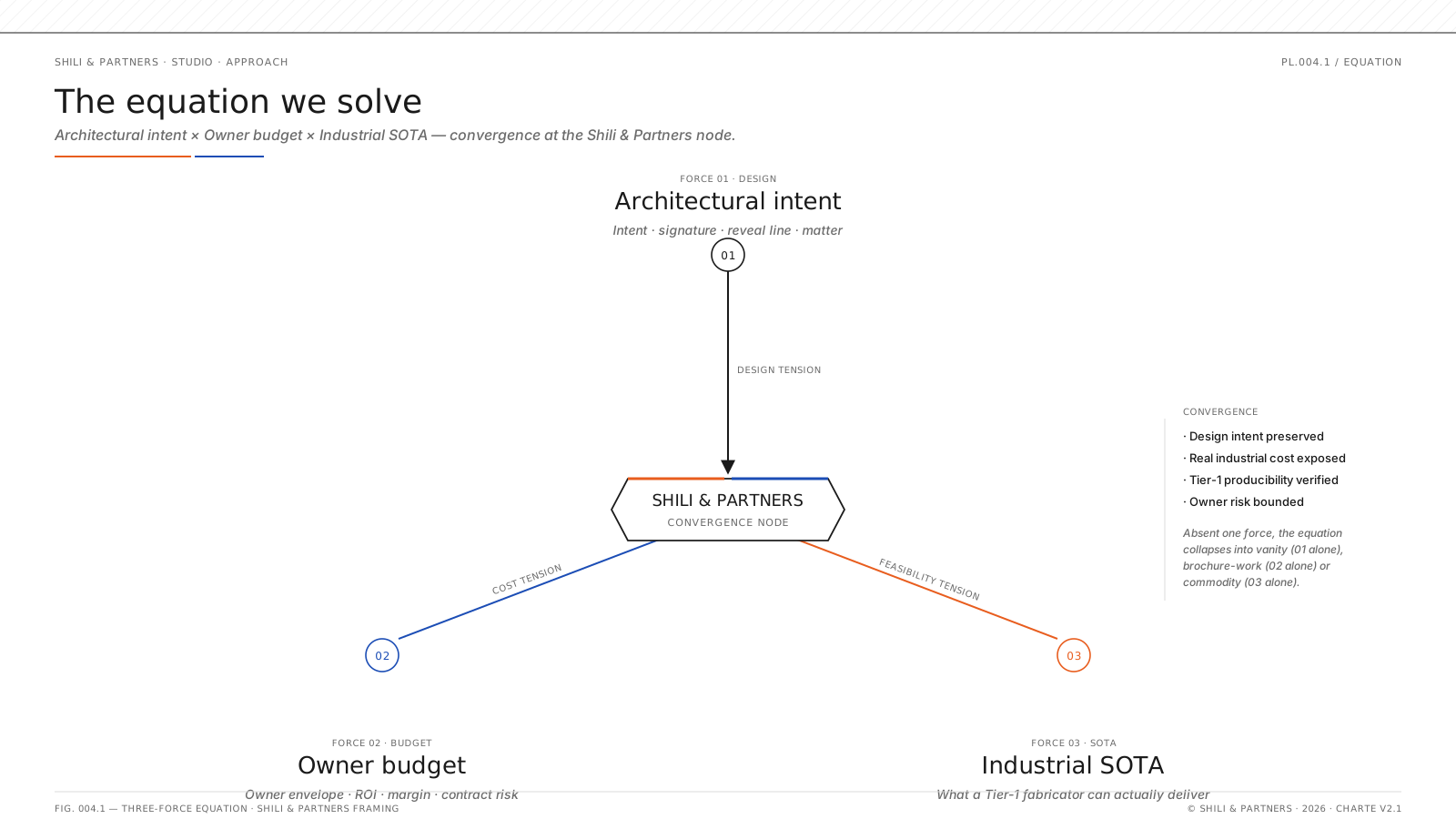
FIG. 02The Design intent × Owner budget × Industrial SOTA equation, three objects in balance, resolved at the centre.
Atelier Shili & Partners
§ TLDR · 01Not a vendor. Not a contractor.
§ TLDR · 02Intent × Budget × SOTA.
§ TLDR · 03Neutrality verifiable, not posture.
§ TLDR · 04Specify performance, not products.
01· Plate, the equation we solve

The equation we solve.

On every mission, we work on the same fundamental equation, Design intent × Owner budget × Industrial SOTA. Three imperatives widely considered incompatible because each actor holds one or two of them at a time.

Force 01Force 02Force 03
§ 01 · Intent

Design intent

The architect holds intent but often does not know the real industrial cost. Preserve the surface reading, the constructive system coherence, the aesthetic invariants. Without industrial counterweight, intent is sacrificed at the last moment because it has not been priced.

→ Form · material · light · presence
§ 02 · Budget

Owner budget

The conventional engineer calibrates budget but cannot push feasibility toward advanced manufacturing. The contractor knows the industrial but optimises margin, not intent or owner budget. Holding the owner budget without pulling quality down requires a third stance.

→ Economic frame held, intent preserved
§ 03 · SOTA

Industrial SOTA

The contractor knows the state of the art but optimises margin. Mobilising what European and international industry can deliver today, and at what cost, requires neutral market knowledge, not commercial dependency on a particular supplier.

→ Advanced processes, commercial neutrality

§ 01Holding all three simultaneously

Our role is to hold all three simultaneously. That requires understanding the architect's design logic, the why behind aesthetic invariants, the reading of the surface, the coherence of the chosen constructive system. It requires knowing real production costs, the cost structures of extruders, glass processors, technical hardware manufacturers. It requires mastering the state of the art, what the most advanced processes in European and international industry can deliver today, and at what cost. When the three imperatives are compatible, we produce an optimised solution. When they are not with existing solutions, we innovate, or we help the owner arbitrate with full information.

§ 02Design integrity

Design integrity, our term for this stance, is the refusal to accept that architectural intent is sacrificed for convenience, but also the refusal to propose a solution that is industrially unachievable or out of budget. Integrity is the rejection of unnecessary compromise.

Arbitration only carries value if it is made explicit : what was retained, what was refused, at what cost, with what alternative. The discipline of design integrity consists of documenting each decision with the same rigour as a calculation note. The owner sees what they buy and what they leave behind ; the architect sees what the envelope preserves of their intent.

§ 02·BDesign to budget, the methodological counterpart

Design integrity has a methodological counterpart : design to budget facade, an explicit arbitration discipline, envelope by envelope, that brings the intent within the budget frame without betraying it. It is not value engineering applied late, when degrees of freedom are exhausted. It is a continuous discipline that begins at concept phase, when costs are still soft and the intent can be protected by smarter constructive choices rather than by amputation. The studio holds both terms simultaneously : never sacrifice intent for convenience, never propose what is industrially unachievable or out of budget.

The equation resolved at the central convergence, stainless welded bracket where three forces meetFIG. 02
02 / 06The equation resolved at the central convergence : a stainless welded bracket where three forces (intent, budget, SOTA) meet.
Atelier Shili & Partners
Three-force convergence diagram, architectural intent, owner budget, industrial state-of-the-art, meeting at the Shili & Partners node at the centre.DIAG. 01
DIAG. 01Three-force convergence diagram : architectural intent, owner budget, industrial SOTA. The central node is Shili & Partners arbitration.
© Shili & Partners 2026
§ Pivot equation
Holding all three simultaneously, that is what distinguishes a studio-laboratory from a generalist consultancy or a prescribing advisor : the capacity to arbitrate is grounded in genuine knowledge of each register, not in moderation between voices.
02· Plate, the four worlds connected

The 4 worlds we connect.

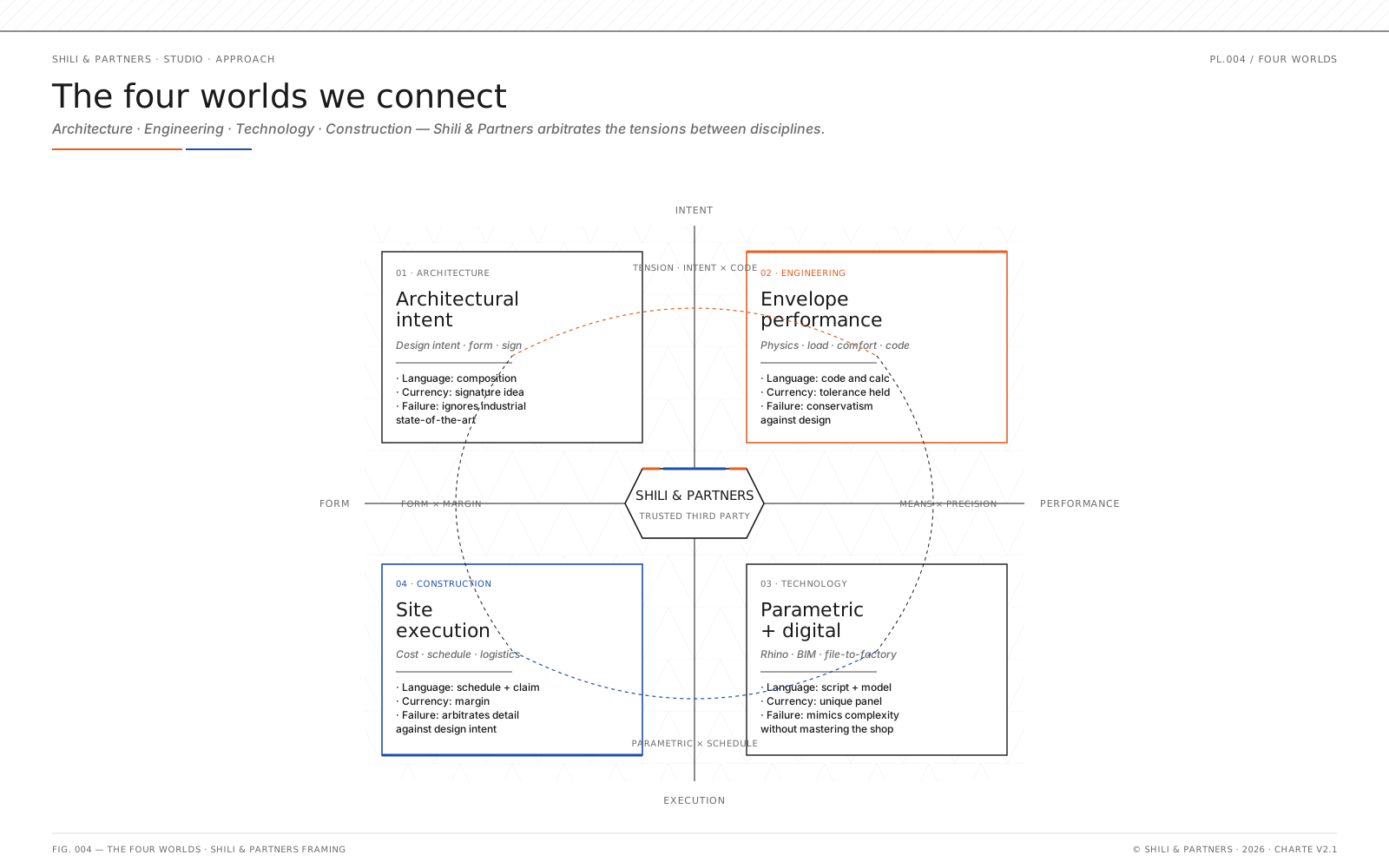
The building envelope is historically a field of tension between four worlds working in silos. Our systemic facade method is to integrate them from the sketch phase, not to reconcile them at the end, when it is too late.

Fig. 03 — Diagramme des tensions, enveloppe multi-acteursPlan 1:1 · réseau · 4 quadrantsVertices 24 · Edges tension 04 · Hub 01Shili & Partners — 2026I — ARCHITECTURECohérence esthétique · signatureINGÉNIERIE — IIPhysique · sécurité · carboneCONSTRUCTION — IVTolérances · supply chainIII — TECHNOLOGIECalcul paramétrique · F2FArchitectureSignature · parti · intentionparti prismatérialitédétail constructiflumière · vuerythme façadeIngénierieBET · normes · calculsstructure · ventacoustique R'wU · psi · gACV · GWPsécurité · feuTechnologieComputational designBIM · IFCparamétriquesimulation CFDfile-to-factoryIA générativeConstructionEG · ET · façadierstolérancessupply chainrisques chantierbudget · aléasunitisationesthétique ⇄ physiquenorme ⇄ détailcalcul ⇄ exécutionparti ⇄ fab.NODE CENTRALS&PAtelier — l'intégrateur——arbitragespecverification
I — Architecture
Architectes signature

Exige l'innovation esthétique et la précision du détail.

II — Ingénierie
BET · normes · calculs

Impose les lois physiques, climatiques, carbone.

III — Technologie
Computational design

Offre des capacités de calcul sous-exploitées.

IV — Construction
EG · ET · façadiers

Subit tolérances, budget, chaîne d'approvisionnement.

Quadrant schematic of Shili & Partners four worlds, Architecture, Engineering, Technology, Construction, with Shili at the centre mediating tensions.DIAG. 02
DIAG. 02Four worlds quadrant : Architecture (intent), Engineering (code), Technology (file-to-factory), Construction (site reality). At the centre, the arbitration.
© Shili & Partners 2026
The four worlds connected, architecture, engineering, technology, construction in quadrantFIG. 03
03 / 06The 4 worlds in quadrant, Shili & Partners at the centre as integrator.
Atelier Shili & Partners

§ 03Architecture

Architecture defines the intent : form, material, light, the interior-exterior relationship, the urban presence. What makes a building that particular building and not another. On the projects where we engage, architectural intent is an invariant to respect, not a constraint to negotiate downward. Our role in dialogue with the architect is twofold : sufficiently fluent in their language to understand their real invariants (what cannot be touched without betraying the project) and their margins of manoeuvre (what can evolve without loss of identity). This discernment, which is not taught in engineering schools, is what makes the dialogue productive.

§ 04Engineering

Engineering imposes the laws of physics, climate, mechanics and carbon. Structure, thermal performance, acoustics, building physics, wind resistance, seismic behaviour, fire behaviour, each dimension has its own requirements and reference standards. SIA, Eurocodes, DTU, FIDIC contractually : engineering is the world of non-negotiable constraints. Our specificity within engineering is the dual competence : rigorous structural and thermal calculation on one side, computational design on the other. Most engineering consultancies can calculate. Few can also model parametrically and optimise geometrically within the calculation process.

§ 05Technology

Technology, simulation, parametric modelling and digital fabrication tools, offers spatial computing and file-to-factory capabilities still under-exploited in the envelope industry. Digital twins applied to fabrication, tolerance simulation, geometric rationalisation through algorithms, direct extraction of manufacturing data from the 3D model, these are optimisation levers that reduce costs, accelerate cycles and reduce claims risk.

§ 06Construction

Construction, general contractors, total contractors, specialist facade companies, system suppliers, manufacturers, bears the tolerance, budget and supply-chain risks generated by the three other worlds. It is in construction that the errors of upstream phases cost the most. Our studio was founded from the construction world. We know what a tolerance imprecision costs on a 20,000 m² curtain wall project. We know what an insufficiently coordinated shop drawing package generates in claims. That knowledge informs our upstream work, from concept phase.

The four worlds do not reconcile through good will ; they connect through method. The method begins at concept phase, when choices are still reversible at marginal cost, and continues through to defects liability period. When only one of the four worlds is missing in the design room, it returns on site as variations, claims or sacrifice of intent. That is the gap our approach is built to close.

§ 06·BThe integrator's posture

Connecting the four worlds is not a matter of weight at the table ; it is a posture. The studio sits at the centre of the quadrant not as a referee but as an integrator, translating each world's constraints into the others' vocabulary. Architects hear performance, structural and cost reasoning ; engineers hear intent and aesthetic invariants ; technologists hear constructive logic and tolerance ; contractors hear design rationale and lifecycle. That translation work is what allows the four registers to converge on a coherent solution rather than diverge into late compromises.


03· Plate, the ethical DNA

Trusted third party, the ethical DNA.

The independent facade advisor positioning is not a commercial tagline. It is an operational constraint we impose on ourselves and make verifiable.

ETHICAL DNA

No affiliation. No hidden commission. No exclusive partnership.

The trusted third party facade stance translates into concrete commitments. No equity affiliation with a manufacturer, system supplier, glass processor, extruder or installation contractor. No hidden commission on technical prescriptions. No exclusive partnership with a software publisher. These rules are not declarations, they are contractual commitments we offer to every client from mandate inception.

Trusted third party, two parties equidistant with neutral mediator in symmetric compositionFIG. 04
04 / 06Two parties equidistant, neutral mediator : the symmetric composition of the trusted third party.
Atelier Shili & Partners

§ 07In practice

In practice : when we recommend a laminated glass with an ionoplast interlayer over standard PVB, it is not because a manufacturer offered us a commercial advantage. It is because the project requires it and the cost premium is justified by performance analysis. When we recommend a ventilated double skin over a single skin, it is not because it generates more revenue for us. It is because it better answers the intent × budget × SOTA equation of that specific project.

§ 08Why this advice is listened to

This documented neutrality is what makes our advice listened to. Institutional owners and investors who work with us know that no commercial motive biases our recommendation. Signature architects know our technical opinion is independent of supply-chain interests. General and total contractors know that our role in a consortium or facade package is to optimise the project, not to favour a particular subcontractor. The trusted third party facade positioning is thus not a slogan but a verifiable operational constraint.

The neutrality commitment is set out in writing in the mandate from signature : zero equity affiliation, zero hidden commission, zero exclusive partnership. This contractual transparency, more than an argument, is an eligibility condition the studio accepts to hold publicly, and that institutional clients can verify at any moment.

§ 08·BThe cost of trust over time

Trust is a slow currency in this industry. It is built mission by mission, through advice that proves itself in execution and through arbitrations that hold under pressure. The studio's neutrality is not a shortcut to that trust ; it is a precondition. Without it, no amount of technical brilliance is enough to be heard at the moment of arbitration. With it, the technical work has the room to land. That is why we treat the neutrality discipline as load-bearing, not decorative.

04· Plate, technological neutrality

Technological neutrality.

Facade neutrality extends beyond the absence of commercial affiliation. It covers the technical solutions themselves, no preferred constructive system, no profile range, no glass brand.

Operational method

On every project, solutions are selected according to that project's specific requirements : thermal performance, structural performance, mass constraints, carbon programme, budget, manufacturing lead time, supply-chain capacity in the project's geographic basin. The recommendation is built from the requirements, not from a predetermined solution.

§ 09Consequence on procurement

This principle has a direct implication on our procurement process : we write specifications that describe expected performance, not product references. A well-written specification allows multiple manufacturers to respond in genuine competition, generating the performance-to-cost optimisation the owner is seeking. A specification biased toward a particular product, sometimes without the owner's awareness, closes that competition and increases project cost.

§ 10The documented exception, Vonbuild

One documented exception : Vonbuild, the AI platform founded by the same studio, may be proposed in complement to certain missions. This proposal is always explicit, never silently embedded in our advice. The client decides with full information.

Specifying performance is not an editorial detail ; it is a political choice that transforms the nature of the tender. When a brief describes what the facade must do (target Uw, AEV class, air permeability, fire behaviour, useful life, demountability), several manufacturers can respond in genuine competition. When it describes a product, the competition is closed before it has begun.
Technological neutrality is not a stance against innovation ; it is a stance against premature lock-in. Suppliers, systems and software evolve continuously, and a project specified around today's product range will be obsolete before its handover. Specifying around performance keeps the door open to better solutions discovered during the design development, and keeps the owner's leverage intact across the procurement cycle.
§ Doctrinal pivot
Specify performance, not product, genuine competition is the optimisation lever for the owner.
05· Plate, systemic thinking

Systemic thinking.

A systemic facade method means we never intervene on a sub-system of the envelope without considering its interactions with the other sub-systems and with the primary structure, every problem is read in its context.

§ 11The thermal bridge as example

A thermal bridge is not an isolated thermal problem, it is the intersection of a structural detail, a material choice, an installation constraint and a regulatory requirement. Solving the thermal bridge without considering the other three dimensions produces a partial solution that generates another problem elsewhere. Every technical challenge is approached in its systemic context.

§ 12At project scale

The same logic applies at project scale. A detail decision at concept phase, the facade-to-structure assembly principle for example, carries consequences for allowable tolerances at execution phase, for claims risk, for procurement flexibility and for the capacity to absorb architectural modifications during design development. These systemic consequences are rarely visible from the single perspective of detail engineering. They are visible from the perspective of an studio that has lived the full chain, from intent to handover.

§ 13The temporal dimension

Systemic thinking also has a temporal dimension : a decision made at concept phase carries consequences that unfold across the project's full lifecycle, through to refurbishment or decommissioning thirty or forty years later. A demountable fixing system allows partial replacement of a failing panel. An accessible structural silicone joint enables refurbishment without complete disassembly. A curtain wall depth that anticipates future thermal upgrade avoids heavy rework when energy performance codes tighten. These decisions do not materially increase the design cost, they cost only the effort of thinking about them. But they transform the building's total cost of ownership across its lifecycle. We document them systematically in our studies, because an institutional owner reasons over thirty years, not only over the handover date.

§ 14The capacity to say no

The systemic facade method, finally, presupposes the capacity to say no. No to a technically seductive solution that is out of budget. No to an optimistic cost estimate that ignores critical interfaces. No to a schedule that does not account for the real fabrication lead time of an oversized glazing unit. This capacity, uncomfortable but necessary, is the counterpart of credibility. A trusted third party facade advisor that says yes to everything is not a trusted third party.

Systemic thinking is also measured by what it preserves over time. A demountable fixing system, an accessible structural silicone joint, a curtain wall depth that anticipates the next generation of energy codes, these are not optional extras ; they are choices that cost almost nothing at design and transform the cost of ownership over thirty years. Documenting these choices, making them visible in the arbitration, is the studio's role.
A trusted third party that always agrees with the loudest voice in the room loses standing within a single project cycle. Holding the line on a non-negotiable interface, on an unrealistic schedule, on a tender that hides margins behind ambiguous specifications, is uncomfortable in the moment and protective over the life of the project. The studio's contractual frame is built precisely to make holding the line possible : engagement modes, fee models, deliverables are structured so that saying no does not put the mission itself at risk.

§ 15Engagement modes and adjacent scope

This same mindset governs how we structure our engagement modes : whether as Owner's Engineer, Lead Envelope Consultant, Operating Partner or within a Design-Build consortium, the commitment is always to hold all four worlds simultaneously, architecture, engineering, technology, construction, in the service of the project. The form of engagement varies ; the method does not. One last consequence : the refusal of scope creep disguised as helpfulness. We do not extend our mission into trades adjacent to the envelope (MEP, structural gross works, interior design) merely because the client would like a single coordinator. Envelope is our domain. When adjacent coordination is needed, we identify the right partner and define a clear liability handover, rather than stretching our competence into areas where the quality would become mediocre. This discipline protects the client's project better than apparent all-inclusiveness would.

§ Final equation
See engagement modes to understand how this approach translates into contractual forms, and how the same systemic discipline shapes Owner's Engineer, Lead Envelope Consultant, Operating Partner and Design-Build commitments.

A project or a company that needs a trusted third party?

Owner's Engineer, Lead Envelope Consultant, Operating Partner, describe the context. We respond on the right engagement form and what it means concretely for your project or company.

Describe the context
Shili & PartnersA Shili Build Ventures company