Expertises/Market guide/BIPV manufacturers

BIPV Market& Manufacturersselection guide.

The BIPV (Building Integrated Photovoltaics) market in 2026 includes leading European and international manufacturers across crystalline silicon, thin-film, organic photovoltaics and emerging perovskite technologies. This guide provides an independent building integrated photovoltaics system market landscape for developers, facility managers and investors considering BIPV integration on new or existing assets. It complements the BIPV energy-generating envelope service sheet with a market-oriented reading. Our advisory is conducted as a technologically neutral third party, without commercial affiliation to any BIPV manufacturer.

BIPV manufacturers comparison, four photovoltaic technology families on workstationPL.160 · BIPV Market
01 / 01BIPV technology families comparison workstation.
© S&P · Sprint 3
01Plate 01 / 06, Market

Market landscape 2026.

The BIPV market in 2026 is structured along four industrial segments : crystalline silicon BIPV on laminated glazing, thin-film BIPV, semi-transparent photovoltaic glass, photovoltaic membranes and flexible panels.

01 / 04Crystalline

Crystalline silicon BIPV

Mature and dominant segment.

Mono-crystalline (18-22 % efficiency) and polycrystalline (15-18 %) cells laminated within architectural glass. European and Asian manufacturers compete on customisation, colour rendition and industrial reliability. Lead times 12-20 weeks.

MonoPoly
02 / 04Thin-film

Thin-film BIPV

Homogeneous dark aesthetic, uniform appearance.

CIGS (Copper Indium Gallium Selenide) and CdTe (Cadmium Telluride) as dominant thin-film technologies. Lower efficiency than crystalline but better low-light performance and more uniform integration into facade patterns.

CIGSCdTe
03 / 04Semi-transparent

Semi-transparent photovoltaic glass

Trade-off between transparency and generation.

Thin crystalline cells or organic photovoltaics (OPV) giving partial vision through the glazing. Typical transmission 10-35 % with corresponding generation capacity. Positioning on signature tertiary and flagship retail.

10-35 %
04 / 04Flexible

Photovoltaic membranes & flexible panels

For large-span roofs and textile structures.

Peel-and-stick OPV or flexible CIGS substrates. Emerging segment with pilot deployments on stadium canopies, pavilions and industrial covers.

OPVFlexible CIGS
En savoir plus
02Plate 02 / 06, Manufacturers

Leading manufacturers.

The leading BIPV manufacturers operate across segments with distinct positioning. Selection considers not only technical performance of the cells but industrial maturity, regional availability, documented warranty track record, compatibility with the specific facade architecture.

Manufacturer landscape by segment

European crystalline BIPV producers : AGC Glass Europe (cell-in-glass lamination with extensive reference portfolio on European signature projects), Ertex Solar (Austria, specialised customisation), Onyx Solar (Spain, mature aesthetic-focused crystalline on architectural glass), Kromatix (Switzerland, coloured BIPV with high-end colour rendition). Thin-film specialists : First Solar (CdTe, North American origin, global reach), Miasole (CIGS flexible), Solibro (CIGS rigid and flexible, German industrial backing). Organic photovoltaic actors : Heliatek (Germany, OPV film on flexible substrates), ASCA (France, OPV developer), Helgenics (Israel). Emerging perovskite and tandem cells : Oxford PV (UK, silicon-perovskite tandem at industrial pilot scale), Saule Technologies (Poland, perovskite on flexible substrate), Swift Solar, Tandem PV. Integrated BIPV solutions providers : some manufacturers deliver full turnkey solutions including structural framing, BMS integration, inverter selection and installation protocols ; others deliver the photovoltaic panel alone and rely on a facade contractor to integrate it.
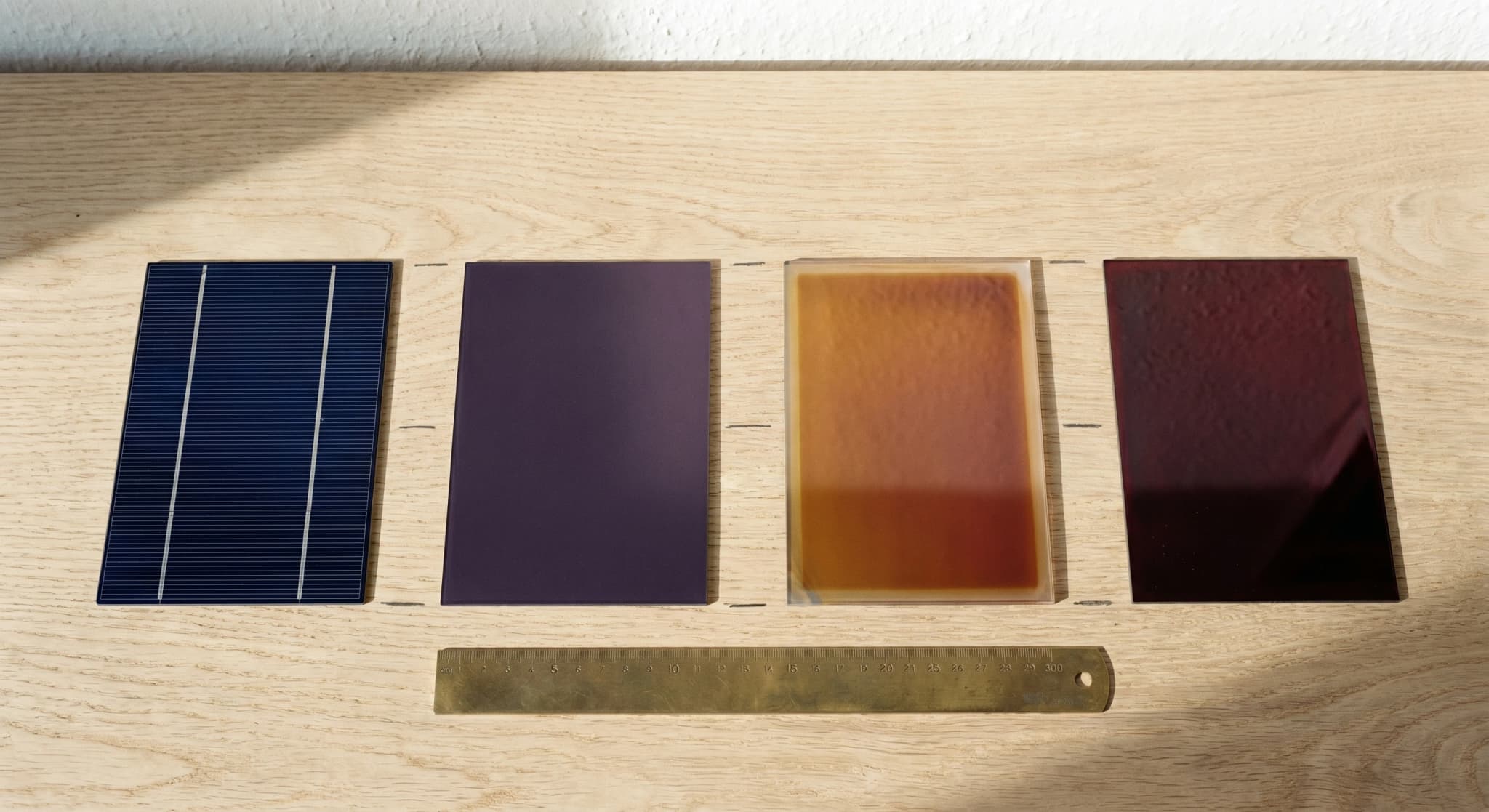
03Plate 03 / 06, Comparison

Technology comparison.

Crystalline vs thin-film vs OPV. A project-relevant technology comparison integrates six criteria : efficiency, aesthetic integration, low-light performance, temperature behaviour, service life, cost.

Six criteria for technology selection

Efficiency : monocrystalline silicon (18-22 %), polycrystalline (15-18 %), CIGS thin-film (13-17 %), CdTe thin-film (16-18 %), OPV (5-12 %, rising), perovskite-silicon tandem (24-29 % in pilot production). Aesthetic integration : monocrystalline visible mosaic pattern unless opaque laminated ; thin-film uniform dark appearance, easier architectural integration ; OPV flexible, coloured, semi-transparent (emerging aesthetic register). Low-light performance : thin-film outperforms crystalline under diffuse and low-angle light. Relevant for vertical facade orientation in high-latitude cities. Temperature behaviour : thin-film loses less efficiency than crystalline at high cell temperature. Relevant for south-facing facades in hot climates. Service life : crystalline 25-30 years typical warranty ; CIGS 20-25 years ; CdTe 25-30 years ; OPV 7-15 years at current maturity, rising. Cost : crystalline cell-in-glass remains the cost reference. Thin-film on larger volumes approaches cost parity per kWh produced. OPV and perovskite are still at premium pricing for unit cost but may offer lower total cost on specific configurations (flexible, lightweight, low-light).

04Plate 04 / 06, ROI

ROI benchmarks.

ROI on a BIPV installation depends on electricity price, solar resource, incentive regime, project configuration and tenure. Indicative ranges for European projects in 2026.

01 / 03Tertiary

Tertiary office HQs

Strong south-east exposure.

Payback typically 8-12 years on well-specified crystalline BIPV facade with self-consumption. ESG alignment and tenant attractiveness can compress this range on high-end assets.

8-12 yr
02 / 03Residential

Signature residential tower

Lower self-consumption density typical.

Payback 10-15 years. Patrimonial valuation uplift and Minergie-P-ECO or BBCA alignment can justify the investment below the strict financial payback.

10-15 yr
03 / 03Public

Public institutional

Regulatory incentives and mandatory renewable obligations.

BIPV is part of the design obligation, not optional. Payback analysis frames the sizing rather than the go/no-go.

Mandatory
Project-specific ROI model

The project-specific ROI model integrates local electricity pricing evolution, self-consumption ratio realistic estimate, feed-in tariff or collective self-consumption framework, incentive stacking and subsidy capture. We deliver this model as a transparent spreadsheet that the client's financial team can audit and adapt.

05Plate 05 / 06, How we select

How we select for projects.

Our BIPV selection advisory operates on five principles : no manufacturer affiliation, documented criteria, competitive benchmarking, industrial reality check, integration with broader envelope engineering.

Five selection principles

No manufacturer affiliation : no commercial agreement with any BIPV manufacturer. No referral commission. Our fees come exclusively from the client. Documented criteria : every recommendation is supported by a comparison grid specific to the project (technical performance, industrial maturity, warranty quality, aesthetic compatibility, ROI). Competitive benchmarking : we systematically engage two to four manufacturers on each project to benchmark pricing, lead time and customisation depth. No default to a favoured supplier. Industrial reality check : seventeen years in the envelope industry, including several years in pre-construction with a Tier-1 international contractor in glass envelope works, give us direct knowledge of BIPV manufacturers' real production capacities and delivery track records, distinct from their commercial propositions. Integration with the broader envelope engineering : BIPV is one component of the envelope, not a standalone acquisition. Our advisory integrates the BIPV selection with the carbon strategy, the thermal performance, the aesthetic intent and the maintenance protocol of the complete facade. See BIPV energy-generating envelope for the full service scope.

06Plate 06 / 06, Articulation

Continue reading.

Five canonical entries to articulate BIPV market with adjacent practices.

01 / 05BIPV

BIPV facade service

Full service scope on cell-in-glass, thin-film, perovskite.

BIPV
En savoir plus
02 / 05Membranes

Textile membrane

Free-form ETFE/PTFE/PVC + flexible PV.

ETFE
En savoir plus
03 / 05Smart glass

Smart glass advisory

Independent comparative dynamic-glass suppliers.

Dynamic
En savoir plus
04 / 05Carbon

Carbon strategy

Parametric LCA, low-carbon sourcing.

LCA
En savoir plus
05 / 05Doctrine

Technological neutrality

No hidden commission, open arbitration.

Zero affiliation
En savoir plus

A BIPV selection to instruct?

A tertiary asset to equip with a BIPV facade, a signature residential tower at design phase, a public building under renewable-energy obligation, or a portfolio-level BIPV strategy to scope. Describe the project and the regulatory context. We come back with a manufacturer comparison grid adapted to the brief.

BIPV brief
Shili & PartnersA Shili Build Ventures company