01 / 04Palace · seat
Architectural revolving door
Signature work for palace lobbies, diplomatic seats and institutional halls. Central pivot, glazed leaves, continuous or step-by-step motorisation.
PalaceSignature hallClimatic airlock
Three families of mechatronic envelope works structure this scope. The motorised access systems at the high end, the architectural revolving door for palace lobbies, diplomatic seats and signature halls, the secure airlock for banks and embassies, the motorised sliding door at oversized scale for flagships and atriums. The moving and kinetic facades, pivoting blades, mobile panels, architectural louvres and large-format motorised brise-soleil. The motorised ventilation openings, motorised windows, rooflights, top-hung sashes piloted by BMS for controlled natural ventilation in tertiary and institutional buildings. Across all these works, the complexity does not lie in the mechanics themselves, which specialised manufacturers carry, but in the multi-trade integration that makes the work coherent: architecture, kinematics, security, BMS, maintenance.
Four typologies of access works dominate the high-end scope. They share one demand: the architectural revolving door, the secure airlock or the oversized sliding door are not catalogue products, they are bespoke works where the architectural signature, the kinematic fluidity and the operational resilience are designed together from the concept stage onwards.
Signature work for palace lobbies, diplomatic seats and institutional halls. Central pivot, glazed leaves, continuous or step-by-step motorisation.
Interlock airlock for banks, embassies, sensitive seats. Sequential opening cycle, biometric access control, slaved to threat analysis.
Oversized motorised sliding door for retail flagships, museum halls, institutional atriums. Leaves several metres wide, silent mechanism, integration into invisible reveal.
Large-format pivot door or high-end automatic door for signature entrances: discreet motorisation, reveal-flush frames, profiles aligned with the curtain wall grid.
Three typologies dominate the moving envelope. The kinetic facade with pivoting blades or panels gives the building a dynamic expression, where architectural shading becomes a sculptural signature. The large-format motorised louvres and brise-soleil protect against solar overheating while modulating natural light. The dynamic facade and the moving facade answer the same programmatic objective: adapting the envelope in real time to climatic and use conditions.
Mobile blades or pivoting panels slaved to the solar path. Architecture spoken through movement, strong sculptural identity on corporate seats and cultural institutions.
Large-format architectural motorised brise-soleil integrated into the curtain wall grid. Aluminium or stainless steel blades, BMS slaving, climate and visual comfort scenarios.
Large-format motorised solar shading with orientable louvres, integrated into the BMS. Passive thermal comfort, modulation of indoor lighting, reduction of cooling load.
Three typologies of motorised openings equip tertiary, institutional and cultural buildings where controlled natural ventilation replaces or complements mechanical air conditioning. The motorised window at high-facade level, the motorised rooflight at roof level, the motorised top-hung window for fire access: three openings, one common BMS slaving.
Motorised window with friction-stay or projected sash, deployed at high-facade level or on north facades for cross ventilation. BMS control, slaving to air quality and CO₂.
Motorised rooflight at roof level, motorised top-hung window at high-facade level. Smoke venting and natural ventilation. Compliance with EN 12101-2 for smoke exhaust devices.
Natural ventilation piloted by BMS, slaved to CO₂, temperature, humidity and wind sensors. Day, night and frost-protection scenarios. BACnet, KNX, Modbus integration.
The normative corpus of motorised works combines safety in use, BMS integration and smoke venting. Six references structure our practice. They are to be mobilised jointly, never in isolation, because the conformity of a motorised work is multi-reference by construction.
| Attribut | ReferenceEN | ScopeField | ApplicationTypologies |
|---|---|---|---|
| EN 16005 | Safety in use of power-operated pedestrian doors | Rotating hall work, motorised sliding door, high-end automatic door. | |
| EN 13241 | Industrial, commercial and garage doors | Oversized doors, signature logistics access works. | |
| EN 12453 | Safety in use of power-operated doors | All motorised typologies, calculation of forces and cycle times. | |
| EN 12101-2 | Natural smoke and heat exhaust ventilators | Motorised rooflight, motorised top-hung window, smoke evacuation device. | |
| BACnet · KNX | Open BMS protocols | BMS control of openings, integration of climate scenarios. | |
| DTU 36.5 | Installation of external windows and doors | Installation, weather sealing, structural connection of motorised openings. |
A rotating palace work compliant with EN 16005 but not documented against EN 12453 will be refused by the inspection office. A motorised brise-soleil compliant with EN 13561 but not integrated with the BMS protocol will not be accepted by the operator. The conformity of a motorised opening is built by cross-referencing the references, not by addition.
The complex motorised work does not rest on one trade, it rests on five interdependent trades. Our role is to orchestrate these five registers from the concept stage onwards, and to keep them aligned through to handover.
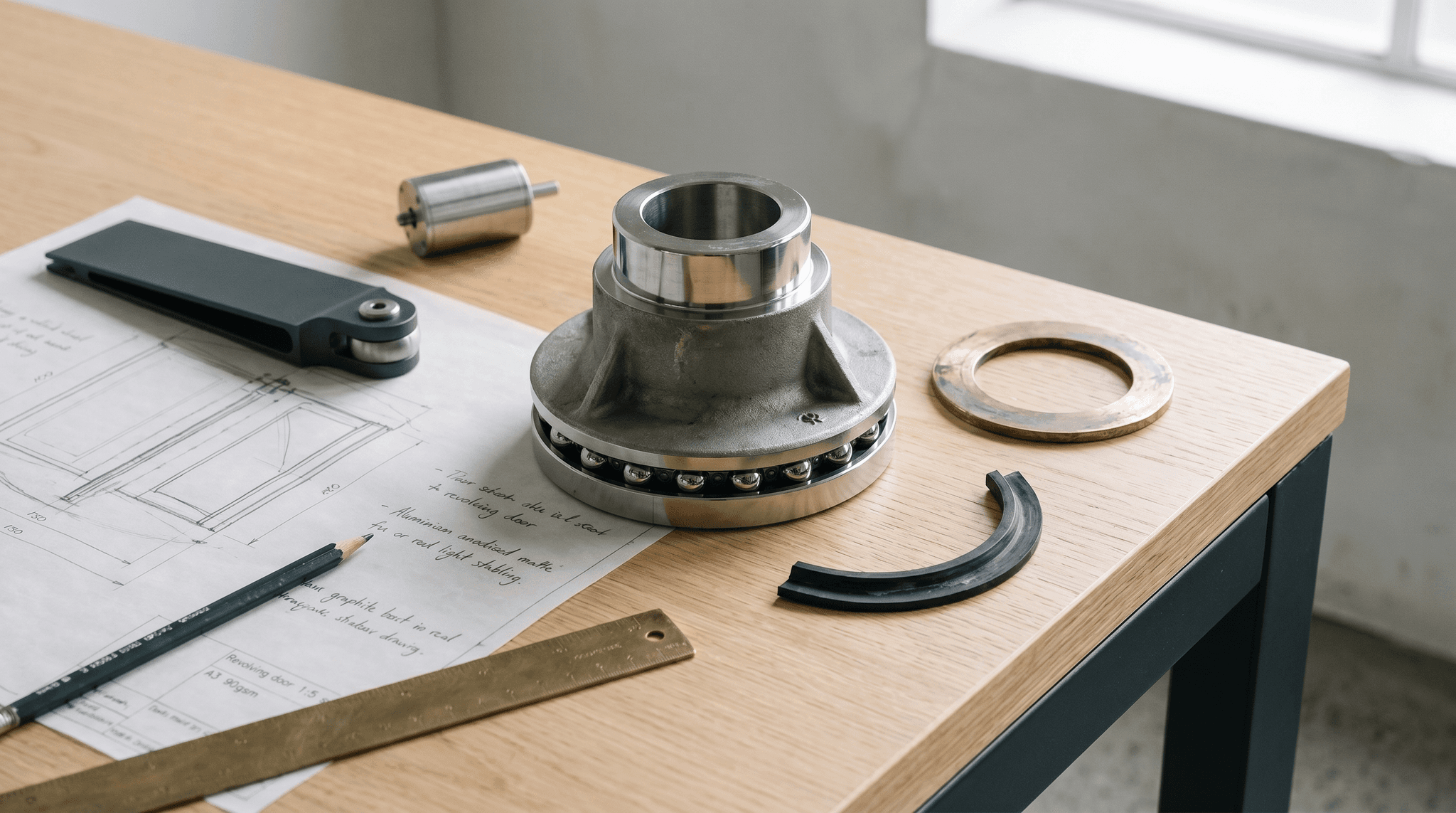 FIG. 05 · Pivot
Alignment with the grid, integration into the reveal, profiles aligned with the curtain wall, controlled visual signals.
Choice of drive, cycle calculation, bearing sizing, energy redundancy, maintenance plan.
Power cabling, low-current BMS lines, redundant control, perimeter sensors, access control.
BACnet, KNX, Modbus, MQTT integration. Climate scenarios, alarms, remote maintenance, operational supervision.
From the pivot axis to the signature entrance. A four-leaf revolving door, a kinetic facade with motorised brise-soleil louvres and a secondary motorised sliding door coexist within the same access sequence, each with its own multi-trade integration.
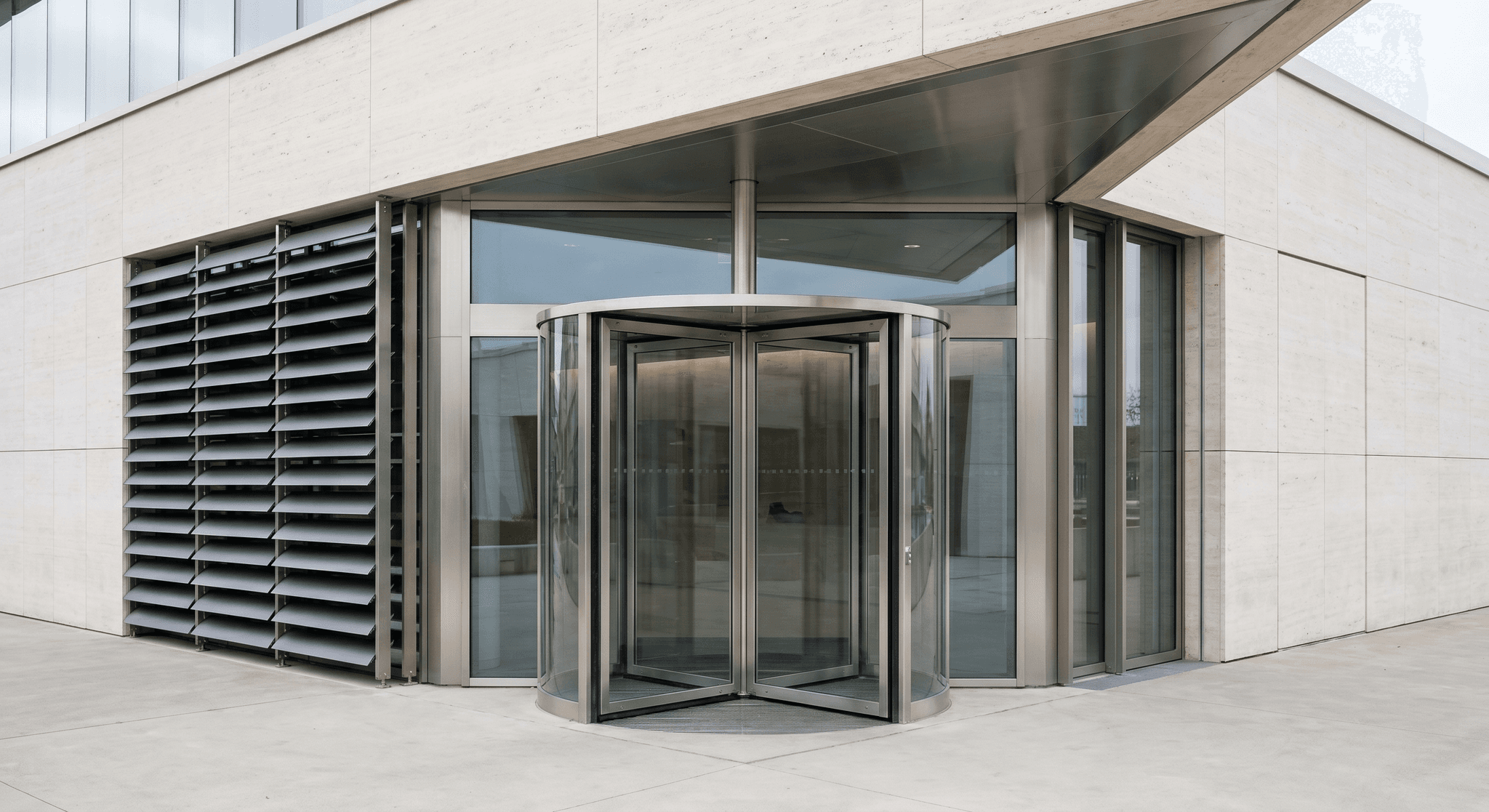 FIG. 06 · Entrance
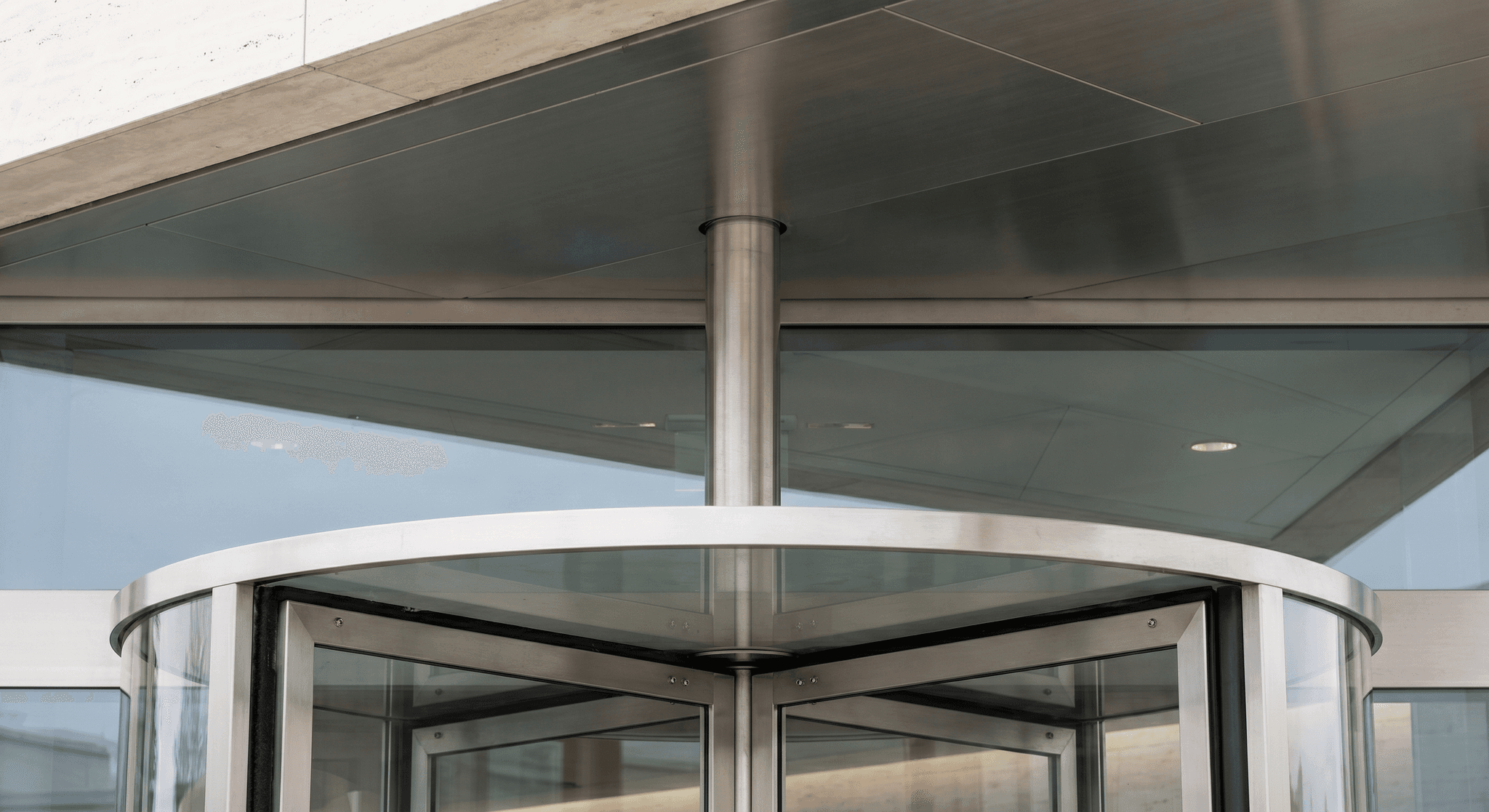 FIG. 06a · Crown
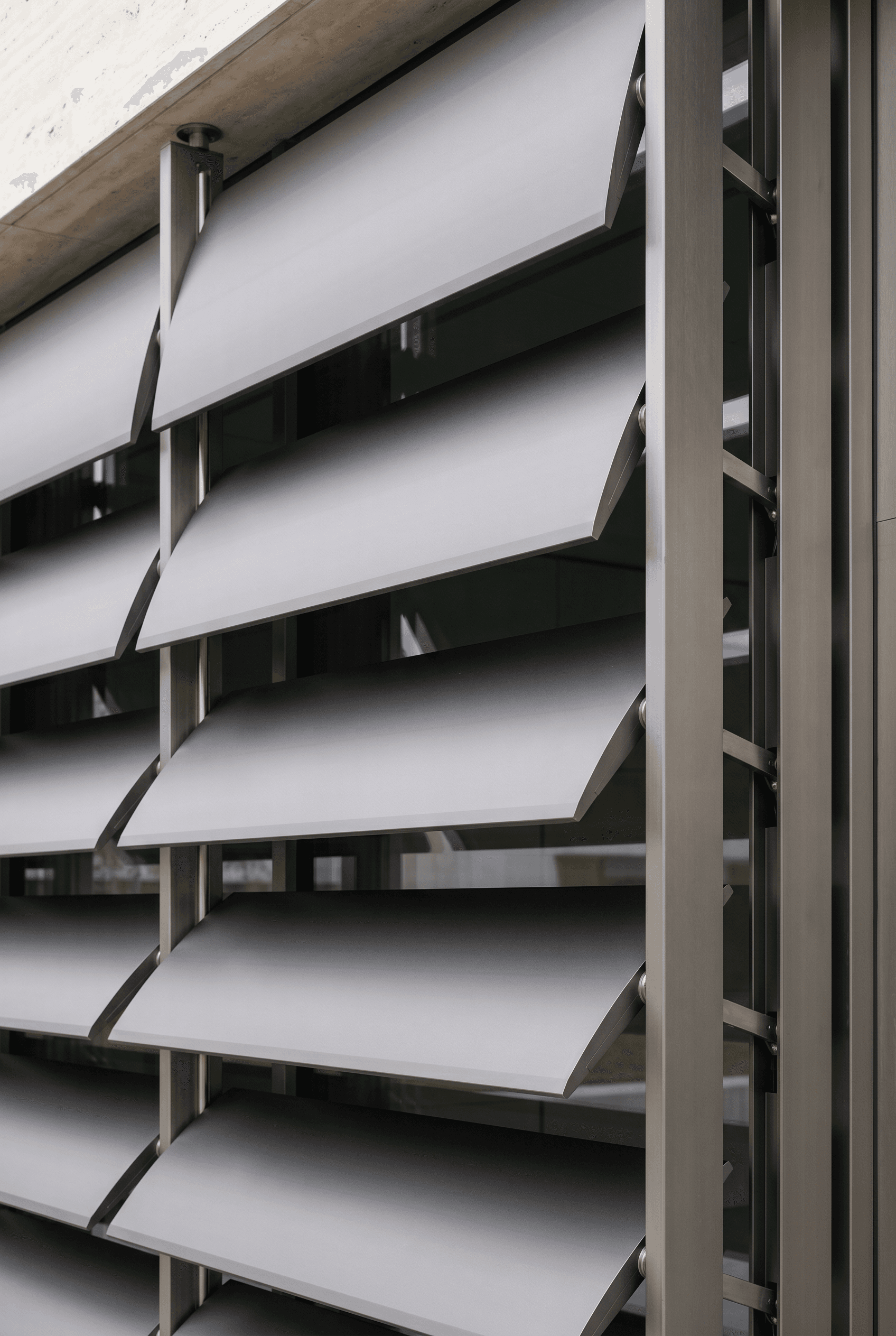 FIG. 06b · Louvres
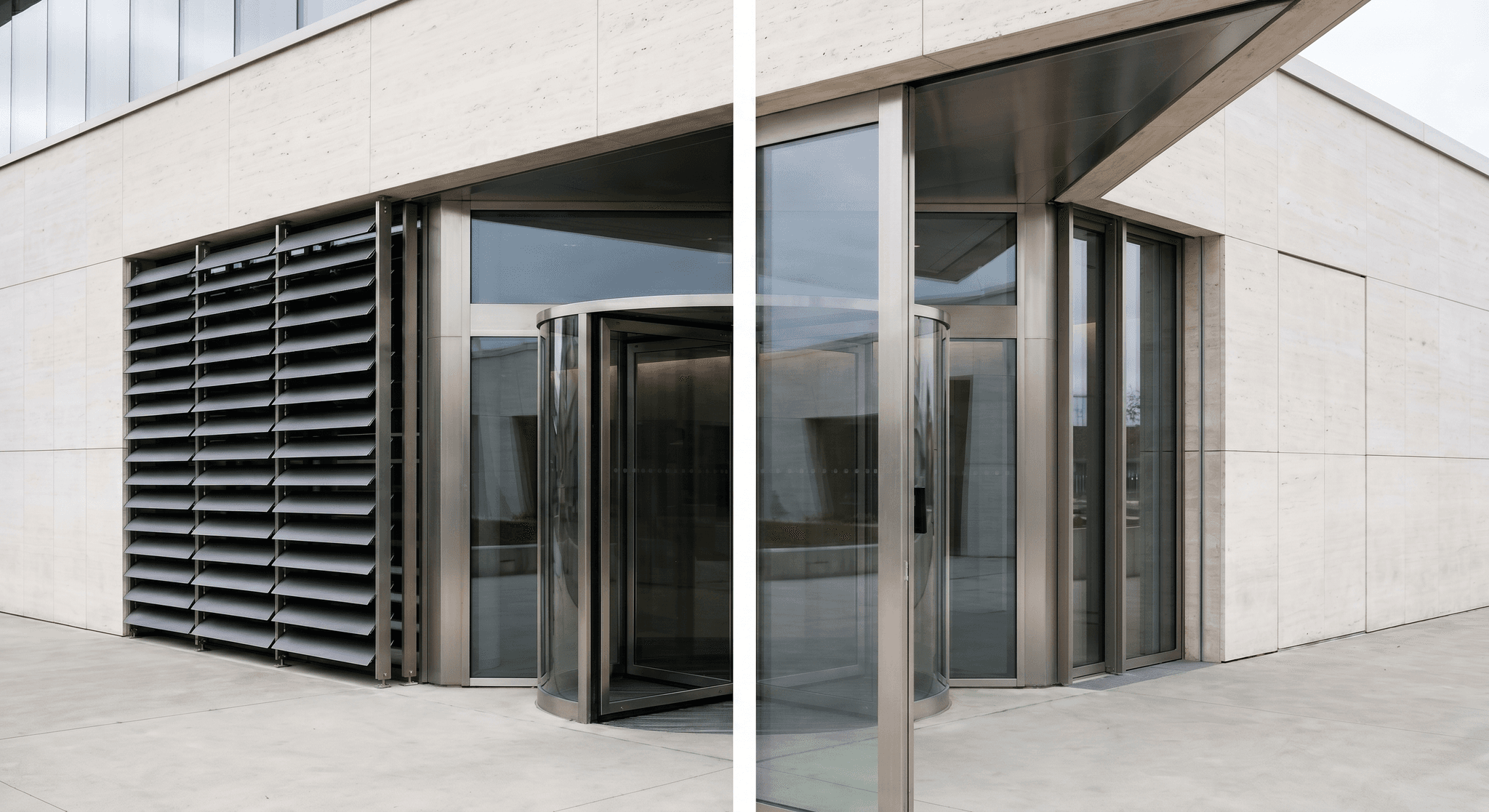 FIG. 06c · Sliding
Three elements structure our practice on complex motorised envelope systems. They converge toward the same promise: an architectural revolving door, a secure airlock, a kinetic facade or a piloted opening system that hold over time, because their integration was thought of as a system, not as an addition of products.
Architecture, mechanics, low-current, BMS, maintenance, aligned on one common reference framework.
The failure of a motorised work almost always comes down to a badly arbitrated interface. Our practice consists of holding, from the concept stage onwards, the perimeter of the five trades, of formulating explicit decisions on each interface, and of protecting them through execution.
No exclusive partnership with a manufacturer of motorisation, automatic door, brise-soleil or opening sash.
On complex motorised works, the European market is concentrated on a handful of specialised industrial actors. We identify, instruct and put these industrial partners into competitive arbitration on a project basis, with no hidden commission. See Technological neutrality.
30-year operational life, preventive visits, remote maintenance, spare parts plan.
A rotating hall work or a kinetic facade has a life cycle of several decades. Maintainability is arbitrated at the concept stage, not at handover: accessibility to parts from inside the building, modularity of the drive to allow replacement without full removal, redundancy of critical components, contractualisation of the maintenance plan with the operator, intervention windows compatible with operations. These early decisions are worth several hundred thousand euros over the life of the work.
Four profiles brief us on complex motorised envelope systems. Each mobilises our practice from a different angle, around the same compass: holding the systemic coherence of a high-end multi-trade integration.
When the rotating hall work, the kinetic facade or the piloted openings are part of the project's sculptural identity.
The signature architect entrusts the atelier with the industrial translation of a sculptural gesture. On a palace, a corporate seat, a museum or an institution, the motorised work is not an operational accessory: it carries part of the design intent. Our role is to preserve that intent through the industrial chain, from the competition detail to installation, without dilution.
Banks, embassies, diplomatic seats, cultural institutions with strong security requirements.
The institutional owner asks for engineering discipline on access works, airlocks and sensitive facades. The secure airlock at an embassy, the rotating hall work and the XXL sliding door of a cultural institution are instructed under NDA, with multi-reference conformity and a maintenance plan contracted over the operational life of the asset.
GCs, engineering teams and inspection offices that need to qualify or execute a motorised work outside the standard scope.
On projects where the motorised work falls outside the usual scope of a GC or an engineering office, our contribution is the specialised interface engineering: analysis of the five interdependent trades, formulation of design decisions, support during costing, qualification of industrial partners, support during commissioning tests and the closing of reservations.
Facade companies that structure their competence on complex motorised works.
For a facade company that wants to extend its scope toward mechatronic envelope works, our role can take the form of engineering support on targeted projects, or of a structured method transfer: normative references, multi-trade integration doctrine, industrial partners, maintenance plan. See Business Engineering.
This specialty connects with our other expertise pages and engagement modes. Six canonical entries to calibrate a combined mission.
Active facade, dynamic glazing, integrated IoT, BMS control. Sister family of envelope mechatronics.
EN 1627. Secure airlock, motorised interlock door, embassies and banks. Passive security reference.
Structural, thermal, computational, interface design. Envelope engineering core.
No hidden commission, no captive system. Documented competitive arbitration of manufacturers.
Owner profile: asset engineering, multi-reference conformity, contracted maintenance plan.
Our eight specialties on risk, signature and envelope mechatronic typologies.